DEBATE
By Peter Tudvad
⚖️ It is rather strange that we in Denmark are currently debating whether a public prosecutor can be objective when she wears a headscarf – that is, a religious symbol. Strange, because we usually idealise the neutrality of the court in the figure of Justitia – the goddess of justice – wearing a blindfold. She does not look at whom she is judging, but only at the case files and other relevant circumstances. So now it is the prosecutor’s headwear, and not the judge’s imaginary blindfold, that preoccupies us.
To me, the debate seems largely abstract. In practice, judges and prosecutors as well as defence lawyers are human beings of flesh and blood. Judges must rule according to the law; prosecutors and defence counsel must present and argue their cases, but always with regard to the facts. Indeed, even prosecutors may not ignore circumstances that point to the defendant’s innocence. The Danish Administration of Justice Act states:
“Public prosecutors shall pursue every case as speedily as its nature permits, and in doing so ensure not only that the guilty are held to account, but also that the innocent are not prosecuted.” (Administration of Justice Act, section 96(2))
But do prosecutors actually do this? My own experience is naturally limited, but I did sit in the dock in Danish courts three times in the 1990s. In two of those cases I was convicted, entirely by the book, of breaking the criminal code, having taken part in civil disobedience during labour and environmental struggles. I duly pleaded guilty and received a suspended sentence and a fine of a thousand kroner respectively. In the third case – chronologically the first – a case that set me on fire and offended my sense of justice, I was suspected of every crime under the sun, even terrorism, but later “only” charged with somewhat lesser offences that could nonetheless have earned me several years in prison.
It was the notorious 18 May case, the case of the worst riots in Denmark since 1945. The year was 1993, the Danes had voted yes to the National Compromise (the Edinburgh Agreement on the Maastricht Treaty), and in Nørrebro, Copenhagen, where I had just moved from my peaceful Jutland hometown of Aarhus, activists ran riot with bonfires and barricades in the street and several tonnes of cobblestones that smashed young police officers on Fælledvej. I myself was arrested an hour and a half after the battle on Fælledvej, in my own street, Peter Fabers Gade, when the police carried out a pincer movement. There I stood on the pavement with my arms folded, ready to be arrested quietly. And so I was – not by being told that the hour was late and that I was under arrest, but by being beaten up and handcuffed.
I had done absolutely nothing, and a few days later my court-appointed defence lawyer, Søren Arentoft, told me I would undoubtedly have the charges dropped, since there was nothing to the case. I had explained in detail what I had done from the morning of 18 May until 2.15 am on the night of 19 May, when I was arrested, and all of it testified to – nothing. But the regional public prosecutor (later Copenhagen’s police director), Hanne Bech Hansen, wanted it otherwise. She insisted that I and a number of other random people – mere bystanders to the riots – be brought to court, where the prosecutor at first was Ole Weikop. He found, as I know in a roundabout way, the indictments Bech Hansen had written absurd and shook his head at them, but had to bring the cases against us, which he did very properly – which is why I, among others, was fully acquitted.
However, the case went on to the High Court, Østre Landsret, which law professor Bent Unmack Larsen once called something like “the system’s own court” in the legal weekly Ugeskrift for Retsvæsen. In my case that proved true. Now the regional prosecutor, Hanne Bech Hansen, argued the cases herself. And the presiding judge was now Ib Dalgas Rasmussen, with some 30 years’ seniority in that very system. With him were two other professional judges and three lay judges. I later got to know one of the lay judges, and he told me, ashamed, that at their first meeting Dalgas Rasmussen had said that “an example must be made here”. In other words, I and others were to be convicted – to make an example. That the example would be that the Danish state under the rule of law could in future criminalise quiet and peaceful witnesses to clashes between police and citizens was simply accepted as part of the bargain – something that would give the police peace to work.
In Østre Landsret I was sentenced to 30 days in prison without probation. The officer who had officially arrested me, Nico Torholt, had already given three mutually contradictory accounts of how my arrest took place – which had led the district court to note in its judgment that his accounts could not be consistent with the truth – and he now reached a total of five. When, having testified against me without daring to look me in the eye, he left the courtroom, I asked to speak in my own defence, which a defendant is entitled to under the Administration of Justice Act (sections 738(1), 866(2), et al.). The presiding judge refused with the words: “No, no, no, we must move on!” I literally exploded with rage and frustration that a High Court judge with 30 years behind him was setting the law aside to nail me, and my defence lawyer, Søren Arentoft, had to push me out of the courtroom. The next day a crestfallen Dalgas Rasmussen opened the hearing by admitting that I should be allowed to speak in my own defence – something which, I later learned from one of the lay judges, one of his professional colleagues had insisted on after the previous day’s hearing, since I was right; indeed, I had the law on my side.
Even so, I was convicted. The court twisted my statement, which was the only thing they had to go on – apart from my arrest in Peter Fabers Gade at 2.15 am on 19 May 1993. At my first court hearing, asked by my defence lawyer whether I had at any point the day before held a cobblestone in my hand, I had honestly answered that yes, I had: I had been talking to a very young girl who was suffering from the tear gas. Just as we were talking about it, she, to my great surprise, picked up a cobblestone from the ground and handed it to me, saying: “Here, make yourself useful!” I took the stone and put it back on the ground, saying: “No, I’m a pacifist!” In its reasons for the conviction, the High Court wrote that “the convicted man had at one point held a cobblestone in his hand, which, however, according to his own statement, he put down”. – Neat, isn’t it? ALL of it was my statement, but the part the court could use as an argument for conviction was presented as objective fact, while the part it could not use was presented as my own subjective account. One would hope to search long for such a singularly dishonest piece of judicial reasoning – but I have my doubts.
Only in the third instance, in the Supreme Court, did I again meet judges who ruled by the book – seven Supreme Court justices who unanimously and unconditionally acquitted me. But reaching that acquittal was by no means a given, because my lawyer needed a so-called third-instance permit from the justice minister, the Social Democrat Bjørn Westh, who at first could not see anything sufficiently fundamental in the case to grant one. Fortunately, his civil servants brought him round.
It is 30 years since I was acquitted by the Supreme Court, and I have had no business in Danish courtrooms since. But now I hear politicians say that a public prosecutor cannot do her job properly in court if she wears a headscarf. You know what, you innocent politicians a thousand light years removed from real reality: her headscarf would in no way decide how I, as a defendant, would see her. Hanne Bech Hansen, who once wrote the indictment against me and pursued it to a conviction – an unjust conviction that violated my rights – wore no headscarf, yet set aside every regard for right and wrong in Danish justice. So, indeed, did the High Court judges, who wore fine robes but no headscarves either. I could not care less how a prosecutor dresses, as long as it is reasonably sober and as long as she does her job, her concrete job as defined by law, properly. If you are so offended by a prosecutor’s headscarf, put on a blindfold so you cannot see it. Perhaps that would finally help the objectivity of the justice system a little.
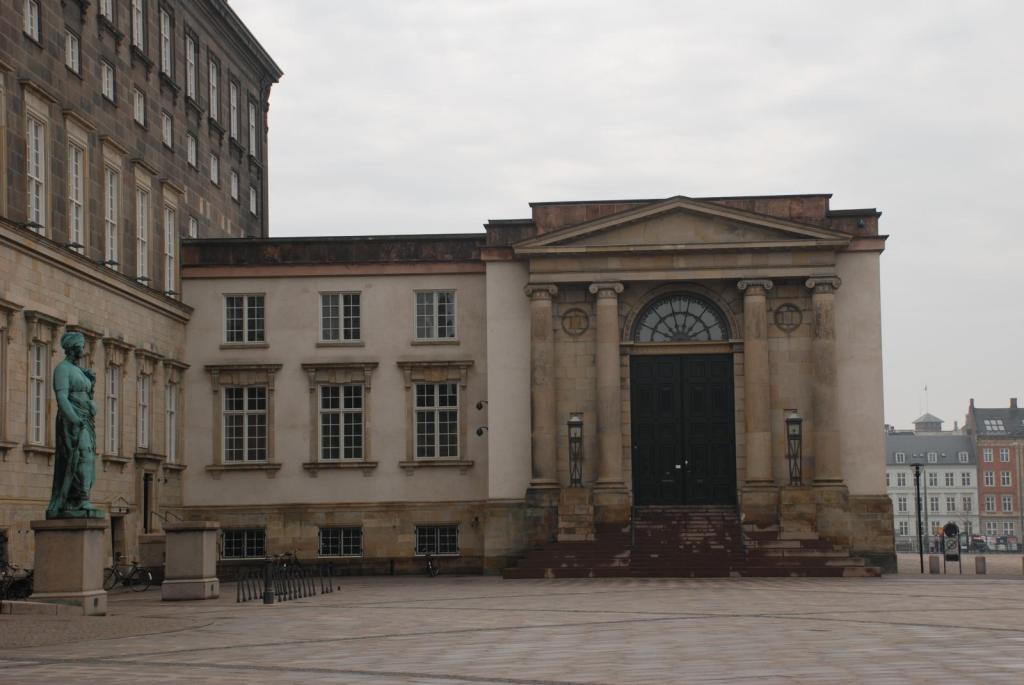
Photo: Creative Commons. Opinion pieces express the writer’s own views. Translated from Danish. First published on bongorama.dk.

Leave a Reply