By Leif Lønsmann
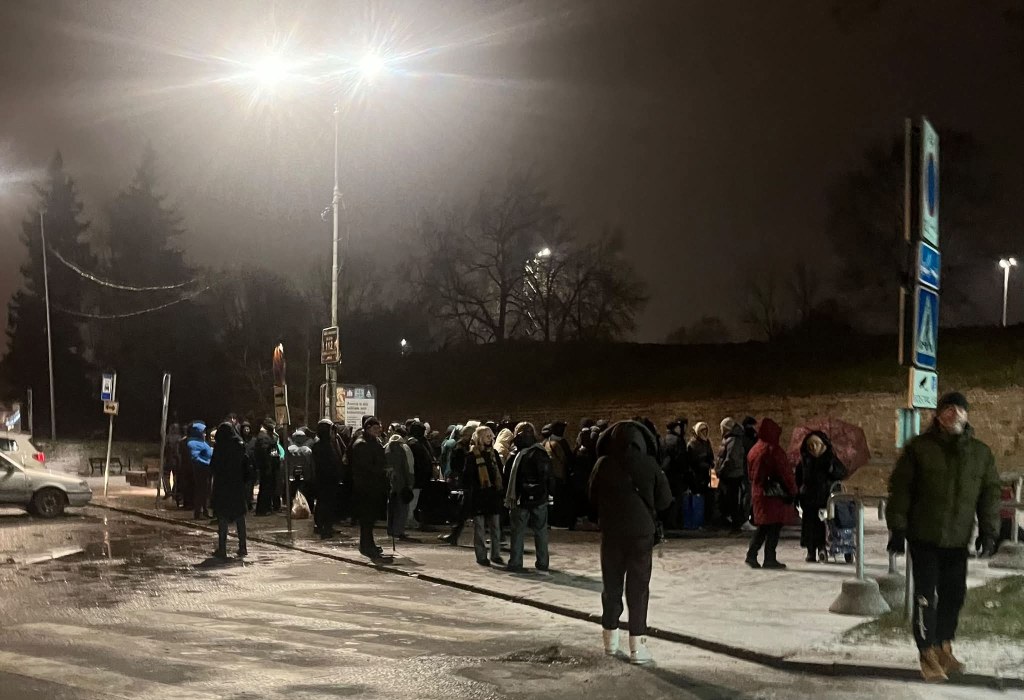
In these days and hours, the queue is growing at the border crossing between the towns of Narva and Ivangorod.
People of all ages wheel or drag their belongings and luggage up to the border station. Silent but unhappy people who must manage to see their family members, workplaces or home towns one last time before the border closes on Tuesday 1 December. Some are openly desperate, frightened or angry. Most are simply silent as they stand in the frost and drifting snow, waiting for the border office to open.
Some are going to visit elderly relatives or newborn grandchildren. Many of them carry Christmas presents, as they will not be able to celebrate the holiday together. Others have their last working day on Monday, because they live on one side and work on the other of the two towns that have grown together along the Narva river. Some will spend the weekend deciding whether to give up their home to keep their job, or give up their job to keep their home. Others are going to visit relatives in hospitals or care homes on the other side of the river. Two 17-year-old girls have decided to visit one of their grandmothers on the other side and say goodbye before the border closes. They have brought home-made presents. They do not know if they will see grandmother again.
The twin town on the Narva has seen and survived several invasions and redrawn borders, and has historically belonged in turn to Denmark, Sweden, Germany, Estonia, Russia and the Soviet Union, just as it has been part of both Livonia and Ingria. After the dissolution of the Soviet Union, the town was split in two in 1991. Narva went to the newly independent Estonia, while Ivangorod became part of Russia. Divided by the Narva river, but since 1960 linked by the 162-metre bridge with the symbolic (or ironic!) name “Friendship Bridge” (Мост «Дружба»).
It is Estonia’s government that has decided to close the border, for “security reasons”. Narva’s mayor, Jaan Toots, has appealed to the government to keep the border open for the people of Narva, on humanitarian grounds: “For some, borders are lines on a map. For others, they are a tragic obstacle to seeing their loved ones, their friends and their family members, who have done nothing other than live or be born on one side or the other.”
Interior minister Igor Taro, for his part, maintains that national security must come before humanitarian concern for the local population. The two clashed on Wednesday on the TV programme “Otse uudistemajast”, Estonian state TV’s equivalent of Denmark’s “Clement Direkte”. The mayor stressed that he respects the security concerns, but believes the border can be controlled without punishing the many residents who have family ties or jobs on the other side.
Estonia’s president, Ülle Madise, who visited Narva in person last week, has tried to bring the two sides together with a compromise proposal for exemptions for residents whose spouses, parents or children live on the Russian side.
The government is standing by its decision, and the mayor sees no other way out than to appeal for mercy ahead of Christmas: “Our people are now writing to Santa Claus in the hope that the government will let them cross the border before Christmas. That is our request to the government.”
Opinion pieces express the writer’s own views. Translated from Danish. First published in Danish on bongorama.dk.

Leave a Reply