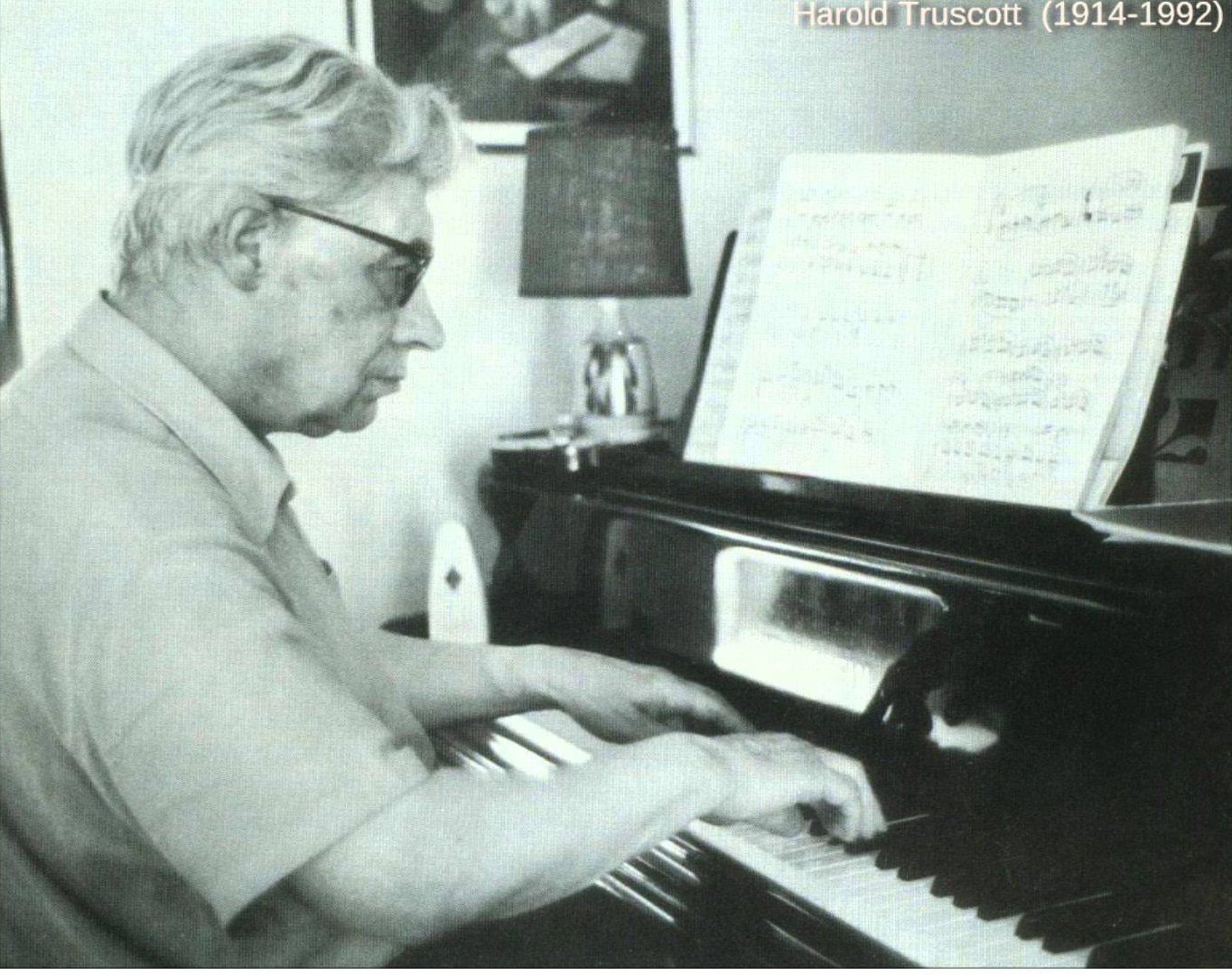
Illustrative music seems to have held no attraction for Harold Truscott, the Grasmere Symphony aside; I have found not the slightest trace of, nor any reference to, any tone poem or such like, though the origins of A window on infinity have yet to be clarified. Even given the likely programme behind the Symphony in E major, the music is intelligible enough without knowledge of it. However, that most expressive of ensembles, the string orchestra, did attract him over a much wider span of his life than could be gleaned from the two scores from 1960-1 catalogued in “E”. The earliest, and most astonishing given its relationship stylistically and in content to the rest of his output, is the Elegy, dated October 1943 and a fully finished composition taking some thirteen minutes in performance. Truscott never publicly acknowledged its existence and it does not appear on any of his worklists, even as one “now discounted”, unless it doubles as the Fantasy for string orchestra of 1944; Truscott may simply have mis-remembered the Elegy’s title and date. The score itself gives no clue as to its genesis, beyond the cryptic note that the “partial quotation from George Butterworth’s Shropshire Lad Rhapsody at bars 53-56 is intentional.” (I am indebted to Michael Barlow, Butterworth’s biographer, for tracing this quotation back through the Rhapsody to its use in the original setting of Housman’s Loveliest of trees, at the words “Is hung with bloom along the bough”.) A big, symphonic adagio in E flat, the Elegy is a work fully worthy of the English string orchestral tradition and is no student or apprentice study. Truscott’s personal voice (as manifested in the post-war piano sonatas) may still not have emerged, yet this is a work of complete mastery. A public performance in post-War Britain might well have changed his life and established him as a composer first and foremost. Its recent recording, as a coupling to the Symphony and Suite, should begin to redress the balance. [Source]
Categories: Music
 BONGORAMA.COM