One of the images symbolizing Japan’s postwar economic boom is a blue-and-white bullet train streaking past Mount Fuji on the world’s first high-speed railway line, which went into service on the eve of the 1964 Tokyo Olympics.
Half a century later, Prime Minister Shinzo Abe wants to use another leap in train technology to demonstrate that even after two decades of economic decline, Japan can still think big. The company that operates the original bullet train, linking Tokyo to Osaka, intends to build a new line that cuts the journey between the two cities to little more than an hour—less than half the current time.
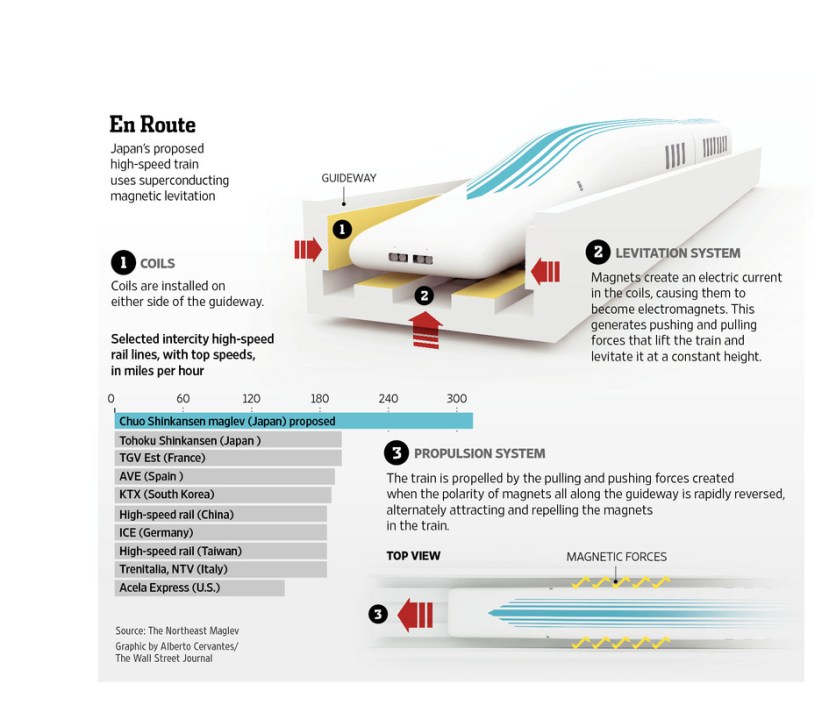
This wouldn’t be any old upgrade. At a projected cost of about $90 billion, it could be the world’s most expensive railway line to date. And it would be the first intercity train to use a technology called magnetic levitation, or maglev, which lifts the cars several inches off a concrete track and whisks them along at more than 500 kilometers, or roughly 310 miles, per hour—nearly 200 kilometers per hour more than the fastest bullet train, or Shinkansen.
Now that several other countries, including China, have developed their own high-speed rail systems, “it is important for Japan to show leadership with a new kind of train,” said Hiroo Ichikawa, a professor at Meiji University in Tokyo and author of a book titled “The True Reason Why the Maglev Will Transform Japan.”
Read the full article in The Wall Street Journal here.
Categories: Technology
 BONGORAMA.COM