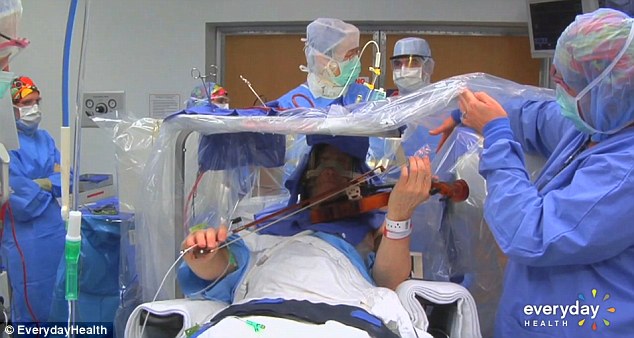
In March 2010, Roger Frisch, associate concertmaster with the Minnesota Orchestra, underwent brain surgery in order to attempt to heal a tremor disorder he had developed that halted his career. According to his Minnesota Orchestra web biography, Mr. Frisch joined the orchestra in 1974 and was appointed associate concertmaster in 1995. His performing, recording and teaching background is impressive and extensive. But beginning in 2009, parts of his brain that control movements were impaired, leaving him unable to bow without shaking.
He was diagnosed with essential tremor, a common tremor whose cause is unknown. At its worst, it may cause a person to lose control of small muscle motions, often in the hands. A string player’s nightmare.
Deep brain stimulation (DBS) involves implantation of an electrode similar to a small pacemaker in the brain to normalize the signals the brain sends to movement centers. Frisch would have experienced no pain from the electrode because brain tissue does not send pain signals. DBS is also used in epileptic patients to control seizures. During the surgery, under the direction of Dr. Kendall Lee and his team at the Mayo Clinic Neural Engineering Lab, surgeons employed DBS to stimulate parts of Frisch’s brain while he played his violin (see video clip below). Fortunately for Frisch, even during the surgery he was able to regain control of his hands. Although he may still have some problems, Frisch can play again.
How and why did this work? Even the surgeons are not sure. It is a dramatic and striking example of the power of mind and violinist communicating in facilitating his performance. The violinist held his playing in his mind, and because of that, his brain guided the surgeons as to where to stimulate the brain. But it’s also a link from his hands and arms that held information that guided his brain and thus his mind, in something akin to multiple feedback loops, each creating the other.
Categories: Technology
 BONGORAMA.COM