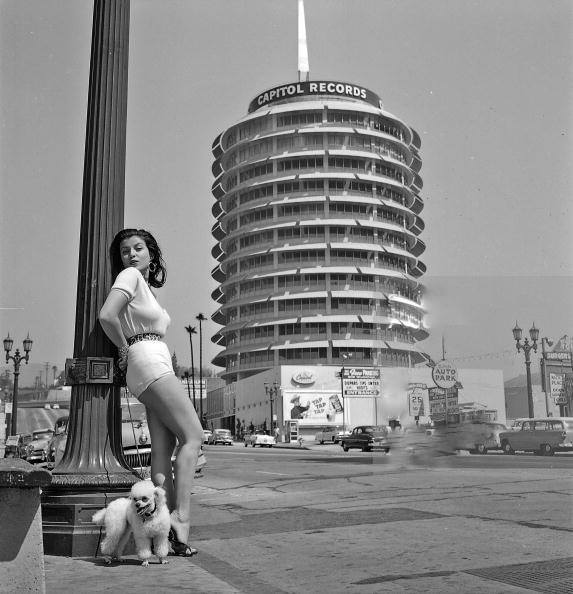
On this date in 1956, the Capitol Records Building, also known as the Capitol Records Tower completed construction and was open for business.
The building design was based upon the graduate school drawings of Lou Naidorf who, as the primary architect, designed the first circular office building at the age of 24 years.The wide curved awnings over windows on each story and the tall spike emerging from the top of the building only coincidentally resembles a stack of records on a turntable. The rectangular ground floor is a separate structure, joined to the tower after completion.
The tower incorporates 13 stories, to conform to the 150-foot (46 m) zoning height limit that was in place at the time of its construction. Height restrictions were later lifted in 1956. The 13th floor of the tower is the “Executive Level” and is represented by an “E” in the building’s two elevators.
The blinking light atop the tower spells out the word “Hollywood” in Morse code, and has done so since the building’s opening in 1956. This was an idea of Capitol’s then president, Alan Livingston, who wanted to subtly advertise Capitol’s status as the first record label with a base on the west coast. The switch was initially activated by Leila Morse, the granddaughter of Samuel Morse.
More Fun Facts.
•The building became known as “The House That Nat Built” due to the vast amounts of records and merchandise that Nat King Cole sold for the company.
•In Earthquake, starring Charlton Heston, the building is destroyed by the quake. A clip of this scene is reused in the pilot episode of Galactica 1980, as Cylon spacecraft fire at the building.
•In the television series Life After People, the building collapses after 175 years without maintenance. The echo chambers underneath the buildings survive intact for many years after the main tower collapses.
•In the film Hancock, the title character pierces the building’s pinnacle with a car in the opening scene.
Categories: Architecture
 BONGORAMA.COM