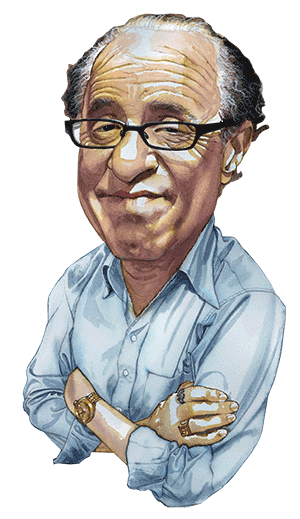
Kurzweil greets me at his door. He is a slim, short man with a genial, baffled manner. Casually dressed in a blue linen shirt with rolled-up sleeves, he shakes my hand with soft hands covered in gold rings (one is from Massachusetts Institute of Technology; another I mistake for a Superman ring is the insignia of the Singularity University he co-founded). His hair is darker than in earlier photographs and he looks like a nerdier brother of Woody Allen. We walk past a Kurzweil music synthesiser, a picture of the White Rabbit from Alice in Wonderland, before arriving in his living room in front of faintly unsettling Monet and Van Gogh paintings — “highly realistic 3D reproductions, done with a laser computer”, he says.
I contemplate a small table set with white china and paper napkins. There is a bowl of berries; a plate with smoked salmon and mackerel; six pieces of dark chocolate; a carton of vanilla WestSoy milk, a pile of Stevia sachets, and a bowl of tepid, dense porridge, that will remain largely uneaten by me. “Cocoa is anti-inflammatory and it’s very good for you. So that’s very dark chocolate with some espresso in. Berries, soy milk, unsweetened. Fish and green tea,” he says, pointing out each item. He eats almost no meat, is pescatarian and favours “healthy carbs and healthy fats. So a healthy carb is a little bit of berries, oatmeal, vegetables.”
Barely minutes into our breakfast we have covered incestuous cats, AI and how to get a job at Google. As his hand hovers over the berries, I tell him I am disappointed not to see his bag of pills. He used to take up to 250 a day; now it is 100. “I’ve found more bio-available forms. So instead of taking 10 pills I can take two.” He has already taken his morning intake of 30 pills (he later shows me a typical bag of them), including ones for “heart health, eye health, sexual health and brain health”. I ask how much this regime costs. “It’s a few thousand dollars a day. But it’s not one size fits all. A healthy 30-year-old might just need basic supplements”
Kurzweil may see into the future but he is also obsessed by his past. He pulls out his father’s PhD thesis on Brahms from 1938 and recounts a Brahms concert Fredric put on in Vienna in 1937. A wealthy Philadelphia woman in the audience was so moved, she told Fredric: “If you ever need anything, let me know.” Following the Anschluss in March 1938, she sponsored his move to America. “You could say that Brahms saved his life.” He remains mesmerised by his late father. “He was generally painfully shy and quiet but when he conducted he was ‘Maestro’ and there would be a party afterwards and everyone would go, ‘Maestro!’ And he’d take his hat off and . . . And he was quite brilliant.”
He cites a 2001 Ted conference in which, using sensors to create an avatar of a female rock singer, he became “Ramona. My voice was turned into her voice. I sang [Jefferson Airplane’s] ‘White Rabbit’. It was considered a drug song but drugs are just one technology to change reality.” Kurzweil slips some chocolate into his mouth before continuing. “I was a different person, a young woman. It really felt quite liberating. And then, obviously, you could be anyone. A couple can become each other.”
As I leave, I walk past his electronic keyboard and ask if he plays. “My repertoire is limited,” he admits. “It peaked.” Surely, I joke, if he is going to live for ever he could be like Bill Murray in the film Groundhog Day who, unable to die, becomes an expert pianist (ice sculptor and French speaker). “There are so many things we could apply our minds to. That’s really the goal of artificial intelligence — to enhance our capacity.”
The above segments are excerpts from this interview in the FT.
Categories: Science
 BONGORAMA.COM