The jazz world has had its share of workplace bullies. Drummer Buddy Rich was notorious for his rudeness and peremptory sackings, and double-bassist Charles Mingus would assault musicians mid-performance if he thought they were playing safe. But no one pushed mind games and punitive measures to greater extremes than the pianist and composer Sun Ra. (He was American officially, but as far as he was concerned he hailed from Saturn.) His band, the Arkestra, had all the trappings of a cult, including a communal life. Punishment was regularly meted out: one musician was locked in a closet for drinking; others were named and shamed onstage. Yet few who met or worked with Ra saw him as a tyrant.
Ra, born Herman Blount in Birmingham, Alabama in 1914, created an ideological collage out of Egyptology and shamanism, B-movie science fiction and Afrocentric philosophy, and wove it into an equally eccentric stage act. Clad in robes, he would sit impassively by his keyboard orchestrating a three-hour spectacle, a working model of the solar system perched on his head.
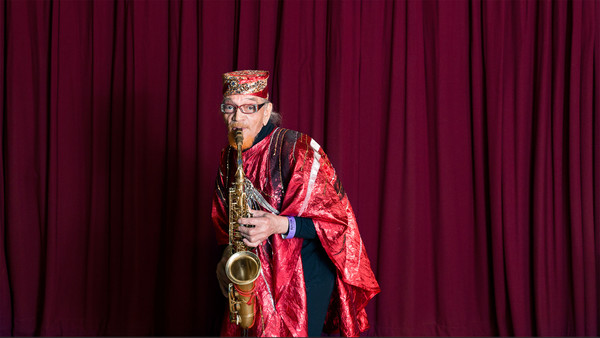
Ra died in 1993, but the Arkestra continues to tour under the direction of saxophonist Marshall Allen and in May it headlines the Cheltenham Jazz Festival in England. Allen joined the Arkestra in 1958 and when I met him recently in London he described Ra’s methods and the epic rehearsals he led. “Ra would write music like you’d write a letter,” says Allen, who turns 91 next month. “Every day he’d have four, five, six new charts.” Ra’s music as written was hard enough. The intervals were difficult and the cross-rhythms complex. “Sometimes you had nothing to hang on to except your part,” says Allen.
But this was only the start. Ra believed that each day had its own vibration or code, and the music needed to be adjusted accordingly. And because he tailor-made parts for each musician, the music changed each time someone new arrived. “You couldn’t come in and pick up your horn and start playing,” says Allen. “He had it fixed so you had to come to rehearse to get the music.” And rehearse you did, every day, sometimes starting at 4am. “I’m not paying you for the gig,” Ra used to tell Allen, “I’m paying for you to rehearse.”
But transcendental intensity was only one component of a cut-and-paste compositional method. Ra was a substantial composer who had a profound influence, way beyond jazz. Nelson cites innovations in sampling, electronics and stagecraft, with a do-it-yourself ethic that predated punk.
The current Arkestra packs the authentic Ra punch. Parts are still tailor-made to each musician and the overall approach remains intact. And they still rehearse in the basement of Allen’s father’s house. “Ra had more control over them than I do,” says Allen. “But it’s the same thing. You learn what you’re supposed to learn and step up.”
The above segments are excerpts from this interview in the FT.
Categories: Jazz Music
 BONGORAMA.COM